
A new documentary revisits a wrongful conviction that stole three teen boys’ lives—and asks what justice really looks like decades later.
For Alfred Chestnut, Andrew Stewart, and Ransom Watkins, freedom came decades too late. Dawn Porter’s new documentary, When a Witness Recants, doesn’t just tell their story—it sits with it, quietly and insistently, until viewers are forced to reckon with what was taken from them and what can never be returned.
The film revisits a case that shook Baltimore in 1983: the fatal shooting of 14-year-old DeWitt Duckett inside Harlem Park Junior High School. In the chaos and fear that followed, police arrested three Black teenagers—Chestnut, Stewart, and Watkins—who would go on to spend more than 30 years in prison for a crime they did not commit. All three were sentenced to life.
Rather than framing the documentary as a traditional true-crime mystery, Porter makes an intentional choice. The question of guilt is never treated as suspense. From the start, viewers know these men were wrongfully convicted.
What the film explores instead is far more unsettling: how easily a system can break young lives, and how the damage echoes long after a conviction is overturned.
Writer Ta-Nehisi Coates, who serves as an executive producer and occasional on-screen presence, provides a personal entry point. He remembers the case from his own youth in Maryland, when stories like this were not shocking but expected. His reflections are not the centerpiece, though.
After setting the cultural and historical context, Coates steps back, allowing the men at the heart of the story to take control of their own narratives.
Now in their 50s, Chestnut, Stewart, and Watkins speak with a mix of restraint, pain, and quiet strength. The film’s interviews are carefully structured, often cross-cutting between the three men as they reflect on childhood, incarceration, and the strange disorientation of returning to a world that moved on without them.
One early image—an empty chair during an interview—serves as a haunting reminder of absence, not only of Duckett’s life but of the years stolen from the wrongly accused.
Porter broadens the film’s perspective by including 2022 legal depositions from key figures in the case. These include Black witnesses who were pressured as children to give false testimony, and the white detective whose investigation helped secure the convictions.
Some express regret. Others deny wrongdoing. The contrast is chilling, revealing how accountability often dissolves over time, even when harm is undeniable.
As the documentary moves backward into the 1980s, archival news footage and home videos take over, immersing viewers in the era’s racial tension and fear-driven policing. For moments that cannot be documented, Porter turns to animation.
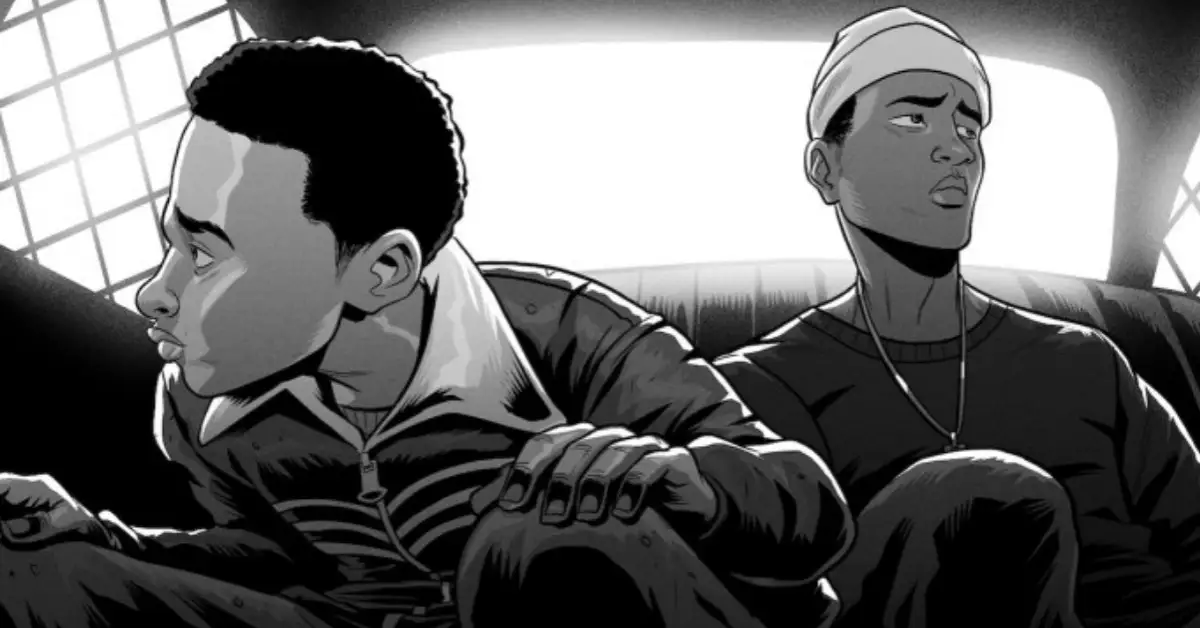
Philadelphia-based comic artist Dawud Anyabwile creates stark black-and-white motion comics that depict the boys as they were—young, scared, and cornered by adults with power.
The animated sequences are not flashy. They are restrained, almost spare, and deeply humanizing. They show how children were treated as suspects first and kids second. In doing so, they quietly push back against the courtroom sketches and media images from the time, which portrayed the boys as menacing adults rather than 16-year-olds with their whole lives ahead of them.
One of the film’s most affecting threads follows Ron Bishop, a classmate who testified against the trio after being coerced by police. His story complicates the idea of innocence and guilt, revealing how trauma spreads outward. Bishop, too, has lived with the weight of that moment for decades.
Porter does not frame him as a villain, but as another young person shaped—and damaged—by the same system.
The documentary pays close attention to small, telling details. The men’s matching “HP3” necklaces hint at a bond forged through shared suffering. No one explains them outright, and that silence matters. Porter trusts the audience to notice, to feel the meaning without being told what to think.
Importantly, When a Witness Recants does not end with exoneration as a triumphant finale. After the convictions are overturned, the film follows what comes next: strained family relationships, lost opportunities, and the unsettling realization that freedom does not equal closure.
One filmed confrontation in the final act allows the men to express emotions they were never permitted to show as boys. It offers release, but not resolution.
The film refuses to label their story as a simple case of “justice served.” That framing would be too neat, too forgiving. Instead, Porter leaves viewers with a harder truth: justice delayed can still be justice denied. Even moments of joy are shadowed by what cannot be restored—time, youth, possibility.
When a Witness Recants is not designed to shock with twists or revelations. Its power lies in its steadiness, its refusal to rush past pain, and its insistence that these lives matter beyond their use as cautionary tales. By centering the voices of Chestnut, Stewart, and Watkins, the film asks viewers to sit with discomfort—and to question how many similar stories never make it to the screen.
In the end, the documentary does not offer easy answers. What it offers instead is something rarer: a space to listen, to witness, and to remember that behind every miscarriage of justice are human beings who must live with the consequences long after the headlines fade.
PHOTO CREDIT: Dawud Anyabwile
