
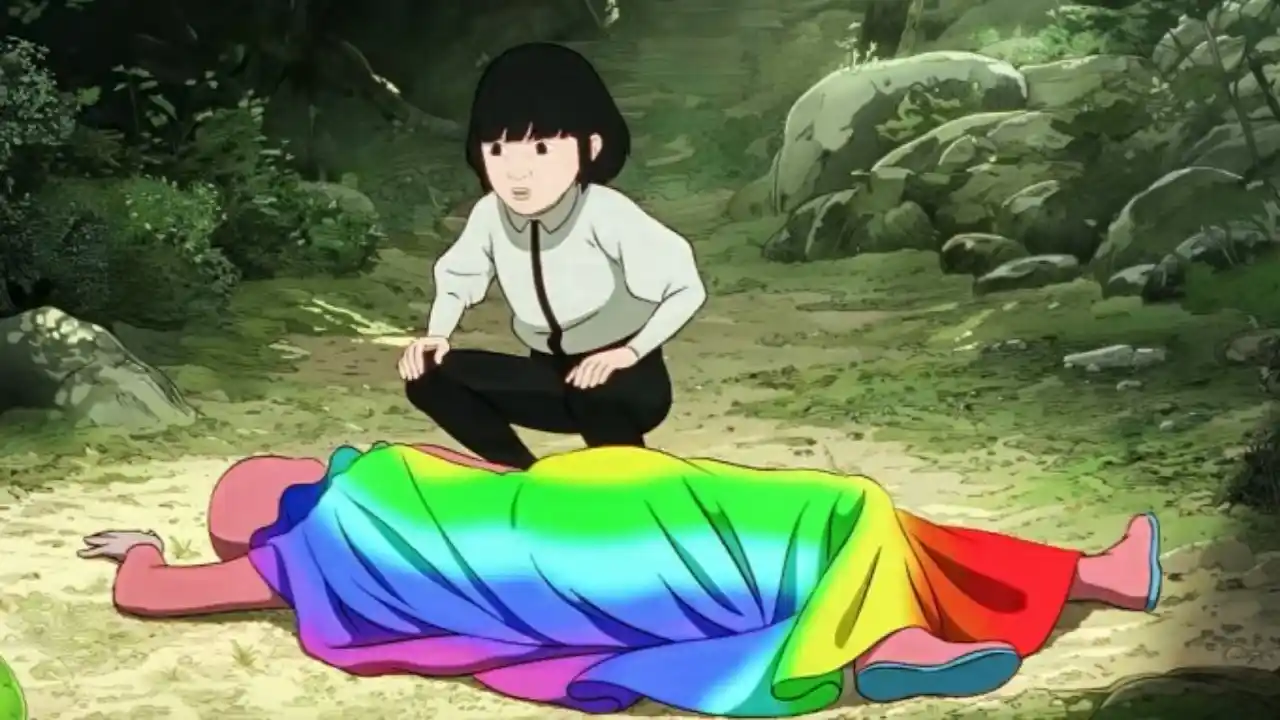
In a future shaped by climate loss, ‘Arco’ follows two kids who remind us that love, choice, and hope still shape tomorrow.
From the outside, Arco might sound like another animated warning about the planet’s future.
The world is hotter. Technology has taken over. Families are separated by work, screens, and distance.
But from the inside, Ugo Bienvenu’s Oscar-nominated debut feels deeply personal — less like a lecture and more like a quiet conversation between generations.
Produced by Natalie Portman, Arco looks at climate change not through numbers or disasters alone, but through childhood. What does it feel like to grow up when nature has changed? What is lost when convenience replaces connection? And what still survives, even then?
Instead of starting with collapse, Bienvenu starts with curiosity.
The film centers on two 10-year-olds from different times. Arco lives in a distant future where humans float above the clouds in homes raised on massive beams. Life is simple, almost stripped down, shaped by a past catastrophe that forced people to rethink how they live with the planet. Iris, on the other hand, lives in 2075 — a world that looks closer to our own future fears. Robots handle daily life. Holograms fill classrooms.
Parents are present only as digital projections.
When Arco steals a rainbow-colored cape that allows time travel — driven by a very kid-like desire to see real dinosaurs — he accidentally crashes into Iris’ time. What follows is not just an adventure, but a meeting of two futures asking questions about our present.
What makes Arco stand out is how normal it lets its children be. Arco isn’t a hero trying to save the world. He’s a child who disobeys, makes mistakes, and doesn’t think through the consequences. Iris isn’t a symbol of technological loneliness.
She’s smart, curious, and quietly aching for attention from parents who love her but are rarely there in person.
Their bond grows not because the plot demands it, but because kids recognize each other’s loneliness quickly. Arco envies Iris’ freedom. Iris envies Arco’s parents, who are physically present and set real limits.
Through simple conversations, the film reveals how different kinds of absence shape children in different eras.
The adults in Arco are not villains. That’s one of the film’s most refreshing choices. Iris’ parents, voiced by Portman and Mark Ruffalo, clearly care about their children. But work — mediated through technology — has pulled them away.
Their robot nanny, Mikki, becomes the emotional center of Iris’ home. Though designed to care, Mikki slowly shows something more: loyalty, courage, and what feels like real love.
This raises one of the film’s quietest but most powerful questions: if care is learned, does it matter who learns it?
Visually, Arco feels hand-touched and warm, even when depicting a colder future. Bienvenu’s characters live somewhere between graphic novel realism and anime softness. The lush backgrounds, full of trees, clouds, and open skies, clearly nod to Hayao Miyazaki’s influence.
Nature is always present — not erased, but changed, waiting.
That choice matters. Most science fiction shows the future as metallic and sealed off from the natural world. Arco insists that even after disaster, nature remains part of the story. It may demand respect, adaptation, and humility — but it does not disappear.
Music plays a key role in shaping that feeling. Arnaud Toulon’s soaring score gives the film an emotional lift that recalls classic adventure movies. When Arco glides across the sky, the moment feels less like escape and more like longing — for freedom, for connection, for a world that still makes sense.
The film does not rush to explain its technology. Time travel works because it needs to. Robots exist because they do. Holograms fill classrooms, including one striking scene where dinosaurs appear as light and code — impressive, educational, and completely untouchable.
The point is not how these things function, but how they feel. And how they feel, often, is empty.
Adults in Iris’ world wear visors that suggest their bodies are present while their minds are elsewhere. It’s a subtle image, but an unsettling one. Bienvenu doesn’t exaggerate. He simply nudges the present forward and asks us to look.
Yet Arco never collapses into despair. Even when environmental disaster threatens the children’s journey home, the film holds onto a belief that change is possible. Not guaranteed, but possible.
One of the film’s strongest themes is responsibility. Bienvenu takes children seriously — not only emotionally, but morally. Arco and Iris are allowed to make mistakes, but they must live with the consequences. Some losses in the film are permanent.
Time cannot always be repaired. Love does not pause while you figure things out.
That honesty gives the story weight. It trusts young viewers to understand that choices matter, and it challenges adults to remember that the future is shaped by everyday decisions, not just big ideas.
In the end, Arco is less about saving the planet than about saving relationships — between parents and children, humans and technology, people and nature. It suggests that climate crisis is not only an environmental problem, but an emotional one.
What we neglect now becomes absence later.
Bienvenu doesn’t promise a perfect tomorrow. He offers something more realistic: the chance for rebirth. If humanity listens, adapts, and remembers what truly matters, the future doesn’t have to be empty.
For an animated film aimed at younger audiences, that message lands with quiet power.
Arco doesn’t shout its warning. It invites us to care — and reminds us that hope, like responsibility, is something we have to choose.
