
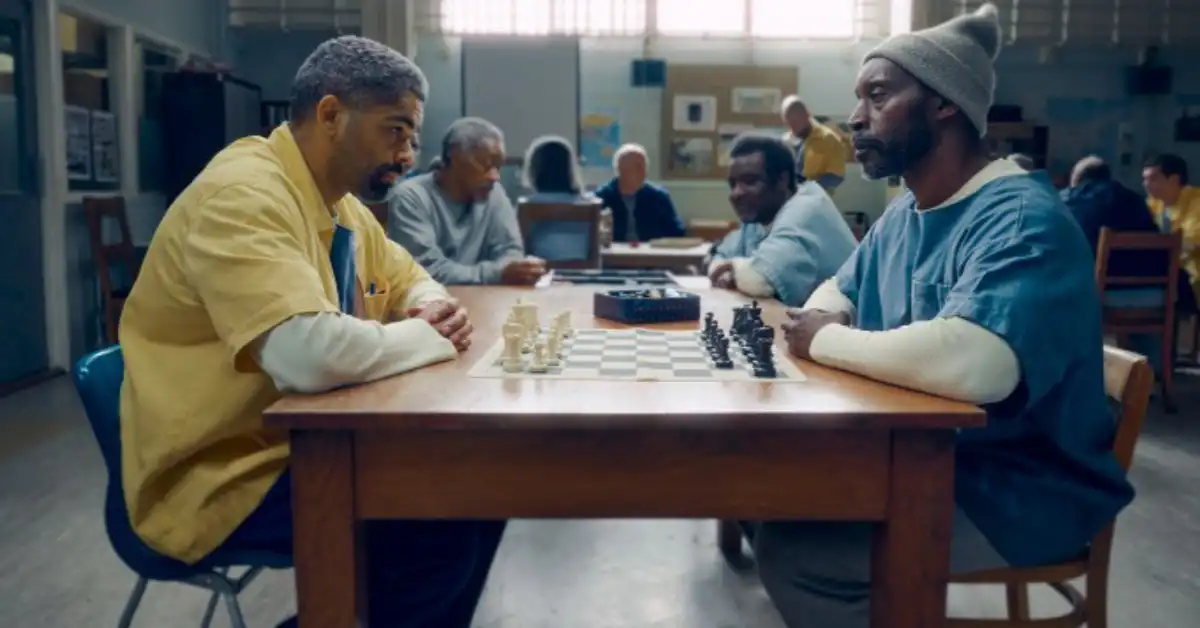
A moving Sundance drama asks a haunting question: what happens to guilt when memory fades behind prison walls?
Prison dramas often focus on crime, punishment, and survival. But Frank & Louis, the newest film from Swiss director Petra Biondina Volpe, takes a much more emotional and thought-provoking route. Premiering at the Sundance Film Festival, the film digs into something rarely explored in movies about incarceration: what happens when guilt and memory collide.
Instead of telling a loud or action-packed story, Frank & Louis moves quietly — and that’s exactly what makes it so powerful.
The film follows Frank Baker, played by Kingsley Ben-Adir, a man who has spent most of his adult life behind bars. Now in his 40s, Frank has been shaped by the prison system for decades. He’s calmer than he used to be, more disciplined, but also carrying the invisible weight of his past mistakes.
When he volunteers to work in the prison’s medical wing, Frank meets Louis Nelson, portrayed by Rob Morgan. Louis is an aging inmate suffering from dementia — a man once feared, now confused, frightened, and slowly losing his sense of reality.
Their relationship begins with tension. Louis resents Frank’s presence, shouting at him to leave his cell. But over time, something fragile and unexpected forms between them.
Frank becomes a quiet witness to Louis’s mental decline, watching as the man’s memories disappear piece by piece.
It’s through this connection that the film finds its emotional heart.
Unlike typical prison films that lean heavily on violence or power struggles, Frank & Louis focuses on empathy. As Frank gets closer to Louis, he begins to understand how terrifying it must be to forget not only who you are, but also why you’re there.
The film also introduces another caretaker, Julian, played by René Pérez Joglar, who looks after inmates with similar conditions. In one of the film’s most striking moments, Julian explains that dementia eventually wipes away everything — even hate. It’s a line that lingers long after the scene ends.
Volpe’s storytelling avoids easy answers. Instead, she invites viewers into a moral gray zone. Frank, who once committed a violent crime at just 18, starts to see his own future reflected in Louis. He wonders whether punishment still means anything if a person can no longer remember their wrongdoing.
That question becomes even heavier when Frank finally faces his parole hearing. Hearing the victim’s daughter speak forces him to confront a truth he’s tried to keep at a distance. While Louis is losing awareness of his past, Frank is being forced to fully face his.
The contrast between them is heartbreaking.
The film doesn’t try to excuse crime or soften its consequences. Instead, it asks deeper questions about justice, memory, and humanity. If someone forgets their crime entirely, are they still paying for it? And if guilt disappears with memory, what does punishment really mean?
Despite its bleak themes, Frank & Louis isn’t without moments of tenderness. Small gestures — a conversation, a shared silence, a bit of care — show how compassion can survive even in the harshest environments.
With a runtime of just over 90 minutes, the movie leaves a lasting impression without ever feeling heavy-handed. The performances are subtle but deeply moving, especially from Ben-Adir and Morgan, who bring quiet complexity to their roles.
By the end, Frank & Louis feels less like a prison movie and more like a meditation on what it means to be human.
At Sundance, it’s already being talked about as one of the festival’s standout films — and for good reason. It doesn’t just tell a story. It stays with you.
PHOTO CREDIT: Sundance Institute/Baker Ashton
