
A daring animated sports tale, “GOAT” blends grit, soul, and fresh visuals to prove heart—not size—still rules the game.
In a movie season crowded with sequels and familiar animation styles, GOAT charges in like a breath of city air after a summer storm.
It’s loud, tender, messy, and alive—and that’s exactly why it works. From the first frames, this animated sports fable makes it clear it’s not here to play by the old rules. It wants to feel like something new, something lived-in, something that belongs to right now.
Set in Vineland, a crumbling yet colorful animal metropolis, GOAT imagines a world where ambition grows between the cracks. Vines creep over broken buildings. Rust stains the basketball-like courts. Beauty and decay coexist, not as opposites, but as partners.
The setting feels less like a backdrop and more like a mood—one that reflects the characters who hustle through it every day.
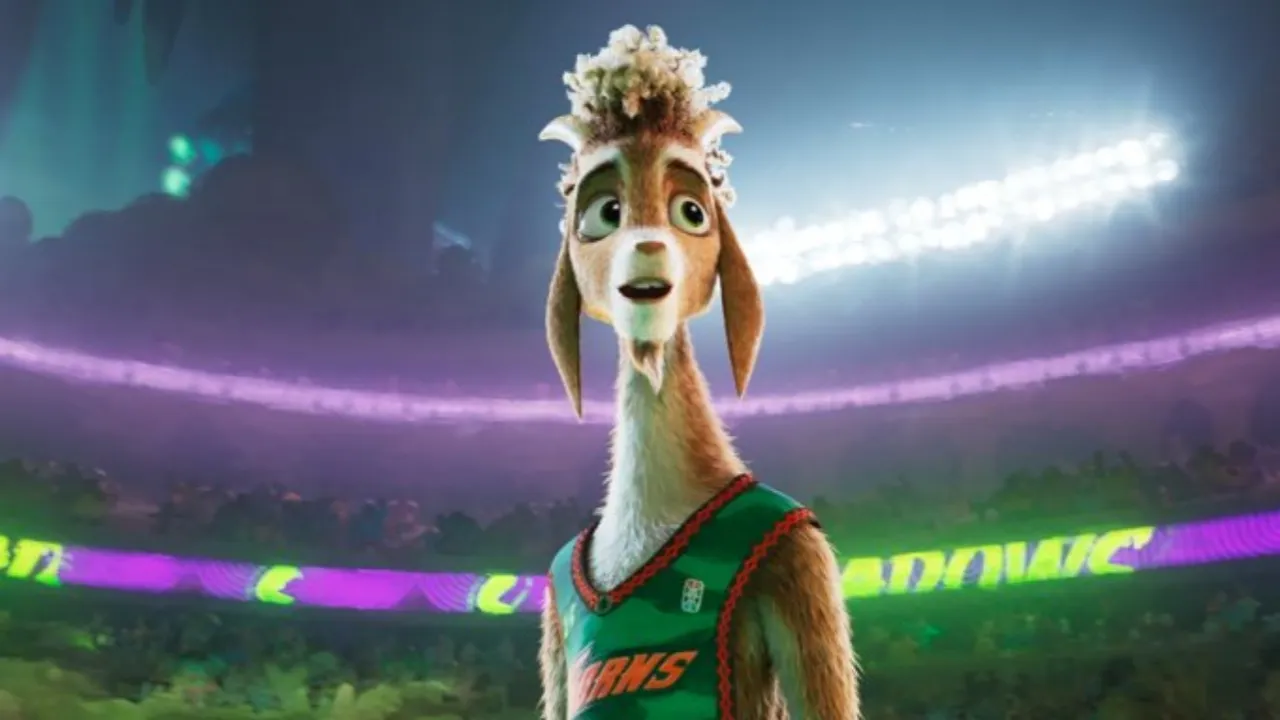
At the center of the story is Will Harris, voiced with warmth and wit by Caleb McLaughlin. Will is a Boer goat with a dream that feels too big for his body and too fragile for his circumstances. As a kid, he’s taken by his hardworking single mom to see the Vineland Thorns play roarball, the city’s favorite sport.
Roarball is a wild, punishing cousin of basketball—faster, rougher, and closer to gladiator combat than a pickup game. For Will, it’s love at first sight.
Years later, the dream hasn’t gone away. Will is grown, scraping by on delivery jobs for the Whisker Diner and fighting eviction. In Vineland’s unspoken caste system, goats like Will are “smalls,” expected to stay in their lane while massive beasts dominate the spotlight. Talent alone isn’t supposed to be enough.
But Will keeps showing up at the Cage, a battered neighborhood court wrapped in chain-link fencing, shooting alone and believing anyway.
That belief is tested when Will crosses paths with Mane Attraction, a dreadlocked Andalusian horse voiced by Aaron Pierre. Mane is swagger and muscle, a rival player who wipes the floor with Will in a one-on-one game. The loss should be the end of the story. Instead, a cleverly edited phone video flips the narrative, making it look like Will came out on top.
The clip goes viral, and suddenly the smallest player in Vineland is impossible to ignore.
Enter Flo, the sharp-tongued warthog who owns the Thorns. Jenifer Lewis voices her with sly humor and hard-earned wisdom. Flo knows a hustle when she sees one, and she knows her team needs new energy. The Thorns are stuck. Their superstar, Jett Fillmore, is aging, and morale is low. Jett—voiced by Gabrielle Union in a standout performance—is all fire and bravado, a panther who dominates the court and the room.
She talks big, throws shade, and commands attention, but the film wisely lets cracks show beneath the confidence.
When Will is brought onto the team, GOAT resists the temptation to turn him into an overnight miracle. He doesn’t suddenly outmuscle everyone. He doesn’t become unbeatable. Instead, he becomes essential in quieter ways. His shooting opens space. His optimism shifts the team’s mood.
His presence reminds the Thorns why they fell in love with the game in the first place.
Director Tyree Dillihay, making his feature debut with co-director Adam Rosette, treats this familiar underdog arc with unusual care. The story beats are recognizable, but the execution feels personal. Each supporting character gets room to be strange and specific. Olivia, an ostrich voiced by Nicola Coughlan, literally buries her head in the ground when despair hits.
Modo, a pierced Komodo dragon brought to manic life by Nick Kroll, radiates chaotic energy, his saliva-flecked enthusiasm barely contained. Even small visual choices—how characters move, slump, or preen—add texture.
The animation style is where GOAT truly breaks away. For years, mainstream animation has chased the same polished realism, a look that once felt magical but now feels expected. GOAT goes another direction. Its backgrounds are painterly and loose, sometimes resembling impressionist canvases. The stadiums are bold fantasy spaces—one court floats above magma, another gleams with ice—each reflecting the emotional stakes of the games played there.
The effect isn’t just eye-catching; it’s expressive.
Music and rhythm play a huge role in shaping the film’s soul. The dialogue snaps with a hip-hop cadence, and the soundtrack knows when to pump adrenaline and when to pull back. One quietly affecting moment comes from Lenny the giraffe, whose delicate cover of “Don’t Dream It’s Over” lands like a deep breath in the middle of chaos.
It’s a reminder that vulnerability can be as powerful as bravado.
What makes GOAT resonate is its refusal to define greatness in narrow terms. Despite the title’s wink, this goat does not become the greatest of all time. He doesn’t need to. The film argues that impact matters more than dominance, that changing the energy of a room can be just as meaningful as winning it outright.
In a culture obsessed with rankings and trophies, that message feels refreshing.
Caleb McLaughlin’s performance anchors that idea. His Will is quick, kind, and emotionally open without being naïve. There’s an ease to the voice work that recalls the modern wave of animated heroes who feel like real kids, not just symbols. Gabrielle Union matches that authenticity, giving Jett a layered presence that balances swagger with self-doubt.
Their dynamic—part mentorship, part mirror—adds emotional weight to the film’s final stretch.
GOAT may not reinvent storytelling from the ground up, but it doesn’t have to. Its victory lies in reanimating familiar themes with sincerity, style, and a sense of place. It understands that dreams don’t grow in perfect conditions. They grow in cluttered apartments, on cracked courts, and in cities that look like Vineland—worn down, colorful, and still reaching.
By the time the credits roll, GOAT feels less like a lecture about believing in yourself and more like an invitation. An invitation to show up, to take the shot, and to bring your whole self with you—even if the world says you’re too small.
In that way, this brash, beautiful animated film doesn’t just tell an underdog story. It lives one.
PHOTO CREDIT: Sony Pictures
