
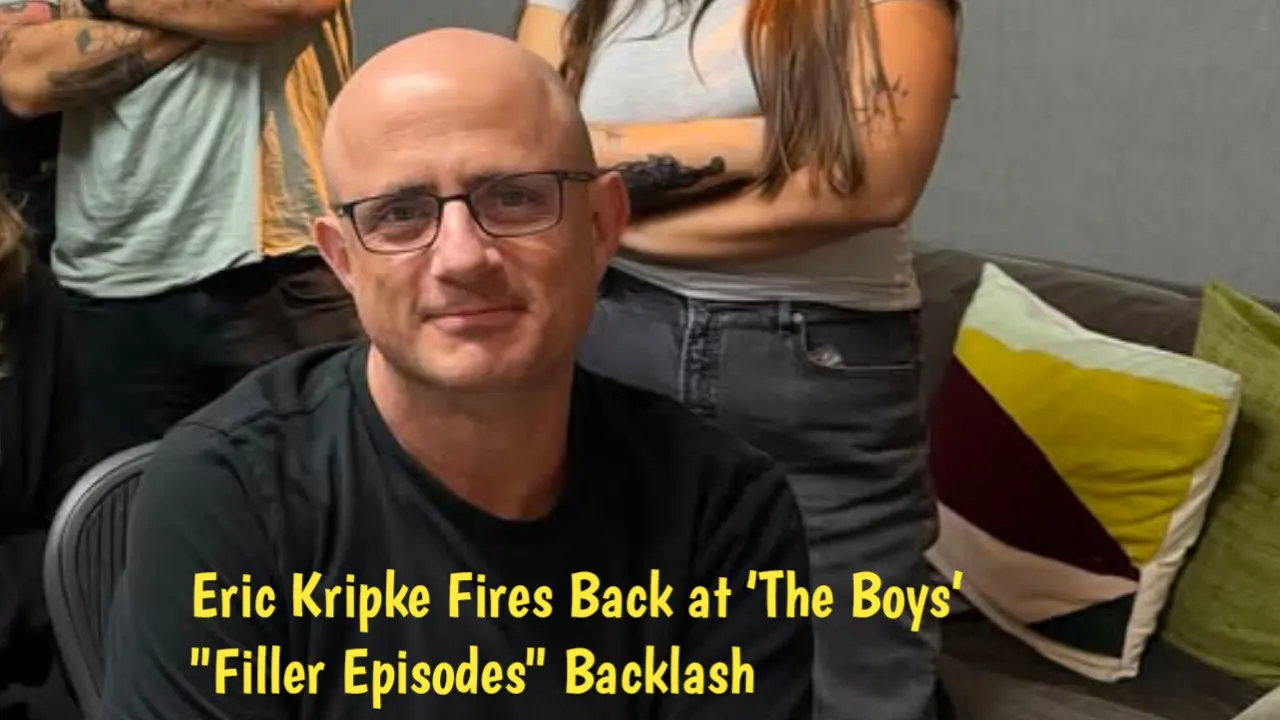
“The Boys” creator stands firm on his character-first approach as Prime Video’s flagship superhero series heads into its final stretch
Eric Kripke, the 2x Emmy-nominated creator of Prime Video’s The Boys, is pushing back hard against a growing wave of fan complaints labeling episodes from the fifth and final season as “filler.” With the series entering its final two episodes — the penultimate installment dropping next Wednesday on Prime Video, followed by the series finale premiering May 19 at 9:30 p.m. in 4DX theaters and streaming the next day — Kripke is making clear he has no regrets about his storytelling choices.
Speaking to TV Guide, Kripke addressed the social media criticism head-on — and didn’t mince words.
“None of the things that happen in the last few episodes will matter if you don’t flesh out the characters. I’m getting a lot of online dissatisfaction, to put it politely,” Kripke said. “And I’m like, ‘What are you expecting? Are you expecting a huge battle scene every episode?'”
The showrunner was equally blunt about the financial realities of the final season, acknowledging that the budget simply does not allow for wall-to-wall action. Leaning into spectacle alone, he argued, would produce something “empty and dull” — nothing more than “shapes moving without having any import.”
READ MORE: ‘The Boys’ Final Season Trailer Teases Homelander’s Darkest Power Grab Yet
“At no point during the writing of it was I like, ‘Oh yeah, we’re making filler episodes. So who cares?'” he said. “We have something like 14 characters, maybe 15. And I owe it to all of them — in that television is the character business — I owe it to all of them to flesh them out and humanize them and their stories.”
He maintained that the season has delivered “crazy, big things” — they just haven’t always arrived in the form of gunfights and explosions. “The craziest, biggest moves happened. It just wasn’t someone shooting someone else going, pew, pew, pew. And if that’s what you want, you’re just watching the wrong show.”
Beyond defending his creative vision, Kripke offered a structural explanation for why the backlash may feel amplified. He suggested that audiences binge-watching the season in one sitting would likely have a very different experience than those waiting seven days between episodes. The weekly release cadence, he argued, makes slower character-driven installments feel more drawn out than they actually are — and that gap aggravates viewers in a way that binge consumption simply doesn’t.
Fan criticism has largely zeroed in on Episodes 4 and 5, with many viewers feeling that the season’s central mission — stopping Homelander (Antony Starr) from obtaining the V-One serum and achieving immortality — effectively stalled. Episode 5, titled “One-Shots,” was the most character-driven installment of the final season and drew significant blowback for its heavy use of celebrity cameos, including Seth Rogen, Kumail Nanjiani, Jared Padalecki, and Misha Collins, which some felt distracted from the main storyline.
One frustrated viewer summed up the sentiment on X: “I think they put everything they had in the finale. And that has left us with loads of filler stuff. Like they wrote two episodes worth of good material and filled the rest with BS.”
The showrunner was specific about which character threads he felt couldn’t be skipped. Wrapping up Firecracker’s (Valorie Curry) arc, deepening the evolving dynamic between Soldier Boy (Jensen Ackles) and Homelander, portraying the growing despair of M.M. (Laz Alonso), and depicting the ideological fracture splitting The Boys between Butcher’s (Karl Urban) camp and Hughie’s (Jack Quaid) — all of it, Kripke insisted, was essential groundwork for the finale to land.
Adding another layer to the conversation, The Boys Season 5 has drawn widespread attention for how closely its political satire mirrors the current American moment — federal troops deployed into cities, citizens detained in so-called “Freedom Camps,” and a megalomaniacal leader growing increasingly unhinged. Kripke has said the parallels were entirely unintentional, and that he’s genuinely unsettled by how on-the-nose the show’s fictional world has come to feel against today’s headlines.
For all his public confidence, Kripke has admitted he is anxious about how audiences will receive the series finale. After five seasons building one of prestige television’s most distinctive and politically charged universes, delivering a satisfying conclusion remains his most consequential creative test yet.
Episode 6, “Though the Heavens Fall,” has been credited with meaningfully advancing the plot, offering some relief to fans who felt the season had been treading water. Whether that momentum carries through to the end will determine The Boys‘ ultimate legacy.
