
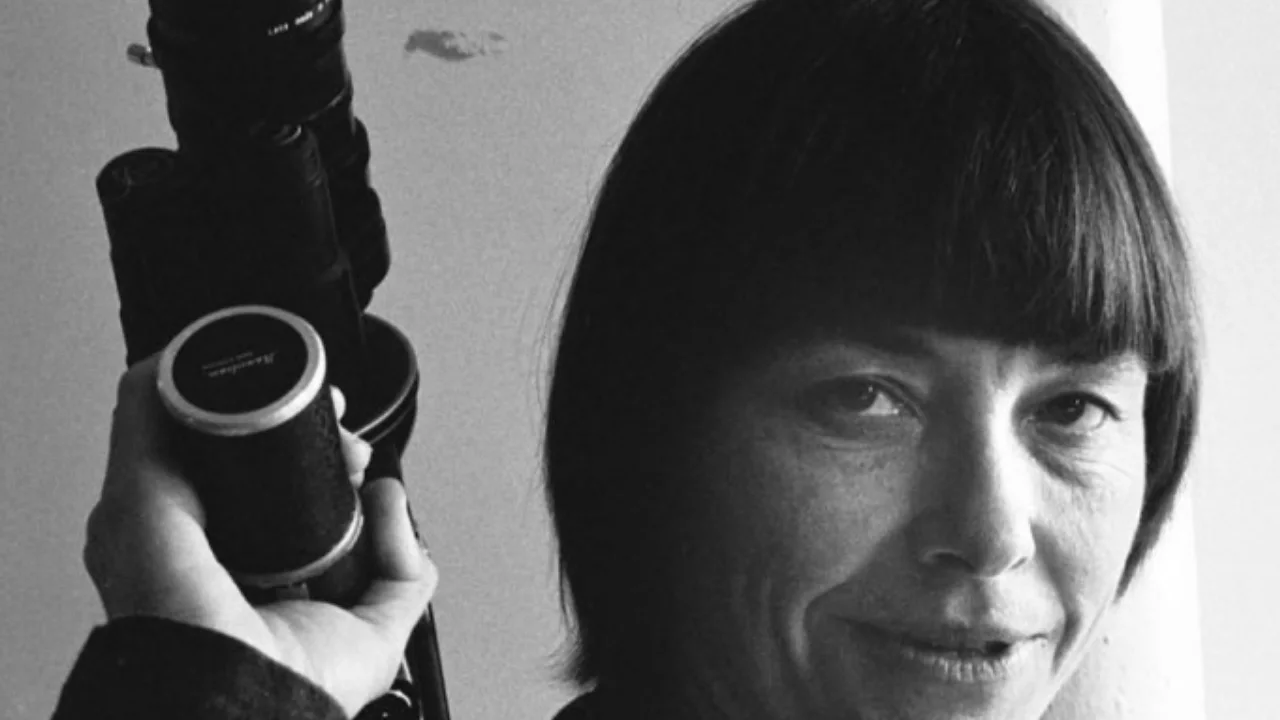
Instead of telling Barbara Hammer’s story, “Barbara Forever” lets the queer film icon speak for herself — loud, fearless, and free.
Barbara Hammer never believed in playing by the rules — and neither does Barbara Forever, the new documentary directed by Brydie O’Connor that honors the trailblazing lesbian filmmaker in the most Hammer-like way possible.
Rather than relying on talking heads, timelines, or tidy explanations, the film is built entirely from Hammer’s own images, words, and creative fire. The result is less a traditional documentary and more an experience — one that pulls viewers directly into Hammer’s radical world.
Hammer, who died in 2019, was a pioneer of experimental cinema and one of the first filmmakers to center lesbian life unapologetically on screen. For decades, she used her body, relationships, politics, and everyday moments as raw material for her art. O’Connor, who spent more than ten years immersed in Hammer’s work, doesn’t try to explain that legacy from the outside.
Instead, she hands the spotlight back to Hammer herself.
From the opening moments, the film makes its mission clear. Hammer’s voice floats over striking, intimate images — many featuring the filmmaker nude, joyful, and unafraid. She declares herself a lesbian filmmaker in a world that often erased queer women entirely. That statement becomes the heartbeat of the film.
This isn’t about proving Hammer mattered. It assumes she did — and shows why.
Rather than starting with Hammer’s childhood or early influences, Barbara Forever begins where Hammer believed her real life started: in 1970, when she came out as a lesbian. From there, the film moves freely through her experiences — love affairs, artistic breakthroughs, political activism, and personal losses — without locking itself into a strict timeline.
It mirrors the way memory actually works: emotional, nonlinear, and layered.
Every image in the documentary comes from Hammer’s own films, some famous, others rarely seen. Her voice, pulled from interviews and recordings, guides the audience through her thoughts on sex, feminism, aging, illness, and art. At times, she’s funny and bold; at others, vulnerable and reflective.
Watching it feels like spending time with Hammer herself, rather than learning about her secondhand.
The film also traces Hammer’s journey from outsider to icon. Early on, her work was dismissed or misunderstood by mainstream institutions. Over time, she became a recognized force in experimental cinema, with her films screened in museums and studied in universities.
O’Connor doesn’t frame this as a victory lap, but as proof of Hammer’s persistence — and her refusal to soften her vision for acceptance.
One of the few voices we hear besides Hammer’s is that of her longtime partner, Florrie Burke. Burke appears cautiously, honoring a promise she made to Hammer to help keep the work alive. Her presence adds emotional weight, especially as the film moves into Hammer’s later years and her battle with cancer.
Love, here, is not sentimentalized — it’s shown as steady, complex, and deeply human.
O’Connor also highlights Hammer’s openness to younger queer artists, including her collaboration with trans filmmaker Joey Carducci. Though Hammer always identified as a lesbian, she believed strongly in queer solidarity across generations and identities.
Through these relationships, Barbara Forever positions Hammer not as a figure frozen in the past, but as someone who would feel right at home in today’s queer art spaces.
What truly sets the documentary apart is O’Connor’s skill as an archivist. Clips from decades apart blend seamlessly, creating the feeling of a single, continuous film rather than a collage of old work. Even without constant labels or explanations, the story holds together — emotional truth guiding the structure more than dates ever could.
Hammer once said she wanted her work to live beyond her lifetime. With Barbara Forever, Brydie O’Connor doesn’t just preserve that legacy — she activates it. The film invites new audiences to discover Hammer not as a historical figure, but as a living, breathing voice that still challenges, inspires, and dares viewers to see the world differently.
In the end, Barbara Forever isn’t just about remembering Barbara Hammer. It’s about letting her remain exactly who she always was: visible, defiant, and impossible to ignore.
PHOTO CREDIT: Barbara Hammer
