
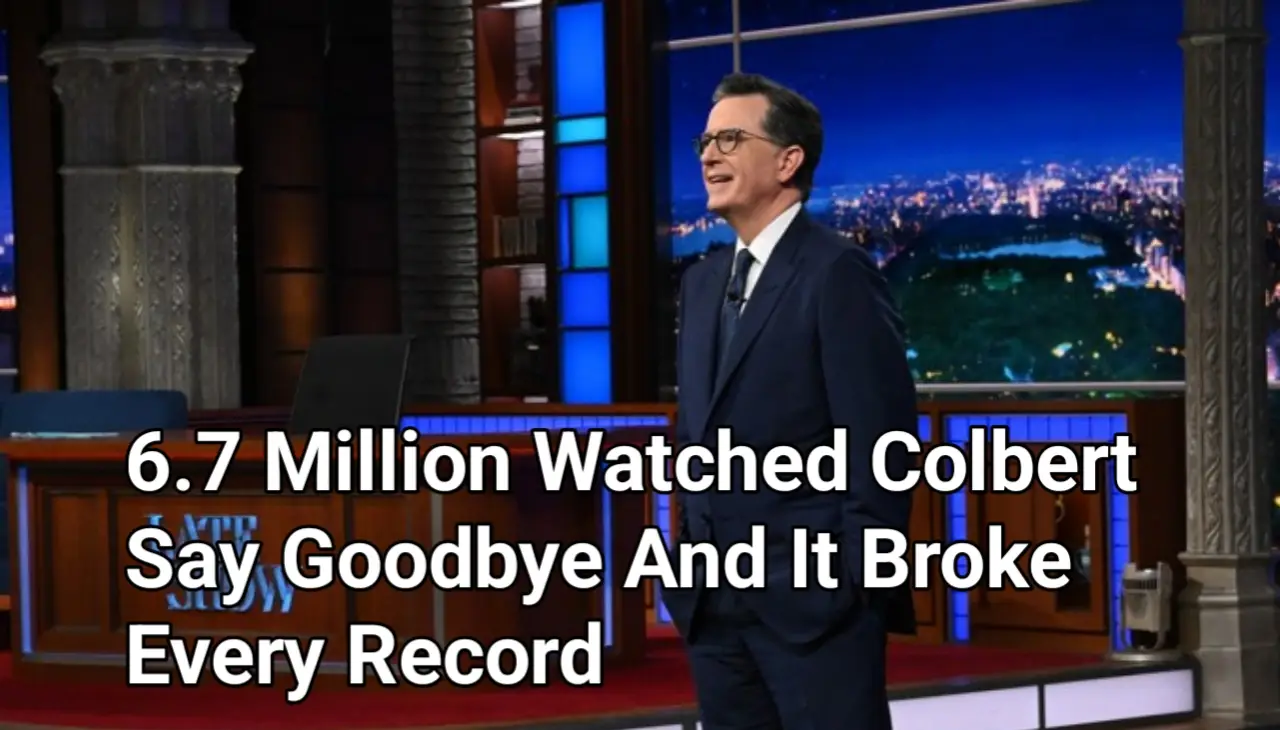
Stephen Colbert stepped away from the Ed Sullivan Theater for the last time on Thursday night, bringing one of television’s longest-running franchises to a close. The finale pulled in 6.74 million viewers—the highest weeknight audience the show had seen during Colbert’s 11-year tenure, and a stark contrast to the program’s struggling ratings over recent years.
A Farewell Nobody Expected
The ending came abruptly for Colbert, who didn’t find out about the cancellation until the night before CBS made it public in July 2025. The network cited financial losses—the show was bleeding roughly $40 to $50 million annually—and made the decision without offering Colbert a replacement role. No successor host was named. No new show was planned for the 11:35 p.m. slot. Just a clean break after 33 years of late-night talk on CBS.
“I’m not being replaced,” Colbert told his audience when the news broke. “This is all just going away.”
The irony wasn’t lost on anyone watching Thursday’s finale: despite bleeding money, the show’s last episode became appointment television.
A Night Built for Spectacle
Colbert had insisted beforehand that he wanted a normal episode—a quiet farewell to what his team does best. That plan lasted about thirty seconds into the show.
Paul McCartney arrived as the final guest, not to chat but to perform. The Beatle brought his new album “The Boys of Dungeon Lane” and a framed photograph from The Beatles’ legendary 1964 Ed Sullivan appearance—the same theater where Colbert had spent the last eleven years. The moment wasn’t subtle. It was a direct line connecting two eras of American television.
Before that came the performances. Colbert sang Elvis Costello’s “Jump Up” alongside Costello and bandleader Jon Batiste. Then came the closing: McCartney, Colbert, Costello, Batiste, and current bandleader Louis Cato all joined in on The Beatles’ “Hello, Goodbye” while staffers danced across the stage.
But the real storytelling was visual. A recurring green wormhole—what astrophysicist Neil deGrasse Tyson identified as an “Einstein-Rosen Bridge”—kept appearing throughout the broadcast. Colbert watched it with confusion and dread. Jon Stewart, his old mentor from “The Daily Show,” appeared in one segment to offer cryptic advice about the hole, as though it represented something Colbert couldn’t quite process or escape.
In the final moments, the wormhole consumed the Ed Sullivan Theater. The building shrank. It was sealed inside a snow globe.
Then darkness.
The Celebrity Parade
The guest list read like a who’s who of television and entertainment. Paul Rudd dropped by. So did Bryan Cranston, Tig Notaro, and Ryan Reynolds (who joked he was auditioning for “final guest” before learning McCartney had already won that role).
Colbert’s late-night peers showed up too: Jimmy Fallon, Jimmy Kimmel, Seth Meyers, and John Oliver all made appearances, signaling a rare moment of industry-wide respect in a landscape usually defined by competition. Earlier in the week, Steven Spielberg had visited. Bruce Springsteen performed. David Letterman, Colbert’s predecessor, came to pay respects.
Even the comedy worked. In one segment, Colbert riffed on a lawsuit involving “Peanuts” music rights. His band immediately began playing “Linus and Lucy,” prompting Colbert to ask if CBS would get sued. It was the kind of sharp, self-aware bit that had defined his show for over a decade.
READ MORE: CBS Blocks Stephen Colbert’s Talarico Interview — It Hits 5.3M Views and Raises $2.5M in 24 Hours
The Internet Reacted Like It Was a National Moment
Before the show even aired Thursday, tributes were already flooding in — from politicians, fellow entertainers, and fans who had been dreading this night for months.
From politicians:
Former President Joe Biden shared a tribute ahead of the finale, writing that Colbert was one of the few people who could make Americans “think and laugh at the same time,” and crediting him for bringing “wit, heart, and honesty” to late-night television. “America could always count on a laugh — and sometimes a needed reality check,” Biden wrote. “Congrats on an incredible run, my friend.”
Former Transportation Secretary Pete Buttigieg posted a video online calling it the “end of an era.” In it, he said: “At a time when algorithms are shaping so much of what people see, hear and even believe, Stephen has been a touchstone shared by millions.” Former Secretary of State Hillary Clinton and Rep. Nancy Pelosi also shared congratulations ahead of the broadcast.
From fellow hosts:
Jimmy Kimmel posted a photo of himself and Colbert together on The Late Show set to Instagram, congratulating his fellow host along with “his writers, staff and crew.”
Jimmy Fallon went a different route — he posted on Instagram with artwork by illustrator Baret Boisson and a quote from “The Lord of the Rings: The Two Towers”: “There’s some good in this world, Mr. Frodo … and it’s worth fighting for.” The choice of quote was pointed: Colbert is famously one of Hollywood’s most devoted Tolkien fans, and he is currently co-writing a new Lord of the Rings screenplay for Warner Bros.
When CBS first announced the cancellation back in July 2025, author Stephen King had posted on X within hours of the news breaking. “Colbert canceled? Please tell me it’s a joke,” King wrote. Actress Rachel Zegler also responded at the time, commenting: “I am extremely sad. I adore you, Stephen.” By Thursday night, those early expressions of disbelief had settled into something quieter — people watching, in real time, as the show actually ended.
Hundreds of fans lined up outside the Ed Sullivan Theater in the rain on Thursday ahead of the final taping. Several spoke to reporters about what the show had meant to them. “We’re just very sad that Steven’s leaving,” one attendee told the BBC. “It’s just gonna leave a big hole in America.”
Variety spoke with Andrea Lobo, a math teacher from Ohio who made the trip to New York for the finale. She didn’t mince words about CBS. “I was not very happy with CBS. At all. They did him dirty,” Lobo said. “I mean, free speech. He should be able to say what he says and not have backlash from the president.”
The other side:
Not every voice online was mourning. Fox News host Greg Gutfeld — whose show had held the top late-night ratings slot for most of 2026 — joked that Colbert was now his “Uber driver.” Some longtime critics of the show repeated familiar complaints about its political tone. Those voices had been louder in July when the cancellation was fresh. On Thursday night, with the show actually going dark, most of the online conversation shifted toward farewell rather than point-scoring.
By Friday morning, the image of Paul McCartney pulling the lever that sealed the Ed Sullivan Theater inside a snow globe had spread to every major platform. For millions who watched from home, that was the image that stayed.
The 11:35 p.m. slot on CBS now belongs to “Comics Unleashed with Byron Allen,” a roundtable comedy show that deliberately avoids political commentary—a sharp pivot from Colbert’s news-driven format. Allen has promised his show will focus purely on comedy without topical discussion.
For Colbert, the immediate future is less certain. He told The New York Times that the show consumes “like 95% of my brain,” and he hasn’t fully mapped out what comes next. What is known: he’s already working on a screenplay for Warner Bros. for a new “Lord of the Rings” film, collaborating with his son Peter McGee and original trilogy director Peter Jackson.
Before that, though, Colbert has two major personal events: his son is graduating from college next week, and his brother is getting married soon. Then comes a train ride to Washington D.C., a vacation from the news cycle, and whatever form his next chapter takes.
The Numbers Tell a Story
The 6.74 million viewers on Thursday marked a temporary resurrection for a show that had been steadily declining. For the first quarter of 2026—just three months before the finale—the show was averaging only 2.69 million viewers per night. Thursday’s audience was nearly 2.5 times that figure.
But context matters. The show’s post-Super Bowl episode in February 2016 had drawn 20.55 million viewers. Letterman’s own farewell in 2015 had pulled in 13.76 million. The late-night landscape has fractured entirely since then. YouTube, social media, and streaming have given viewers infinite options. Watching anything live at 11:35 p.m. is increasingly a choice rather than a default.
Still, 6.74 million people chose to be there Thursday night. They wanted to witness the end.
A Franchise, Officially Over
“The Late Show” debuted in 1993 with David Letterman. It ran for 22 years under his watch—33 years total with Colbert. That’s longer than most marriages, longer than most careers, longer than most people have been alive.
What replaced it isn’t a new “Late Show.” It’s just something different on the same channel at the same time. The franchise itself is gone. There will be no successor, no revival, no eventual comeback. On Thursday night at the Ed Sullivan Theater, an entire era of television simply closed its doors.
Colbert walked out to a standing ovation. The audience was on its feet before a single joke was told. By the end, when McCartney pulled the lever that cut the lights and opened the final wormhole, most people in the room weren’t laughing anymore.
They were saying goodbye.
