
At Sundance, “Wicker” turns a fairy tale into a sharp, funny look at marriage, desire, and what happens when one woman dares to want more.
At a festival known for daring ideas and modern anxieties, Wicker arrives with a wink and a woven twist. The Sundance premiere, starring Olivia Colman and Alexander Skarsgård, looks like a story from another century, but it talks straight to the present. Directed and written by Eleanor Wilson and Alex Huston Fischer, the film uses fantasy to ask a very real question: What if a woman could order exactly what she wants — and actually get it?
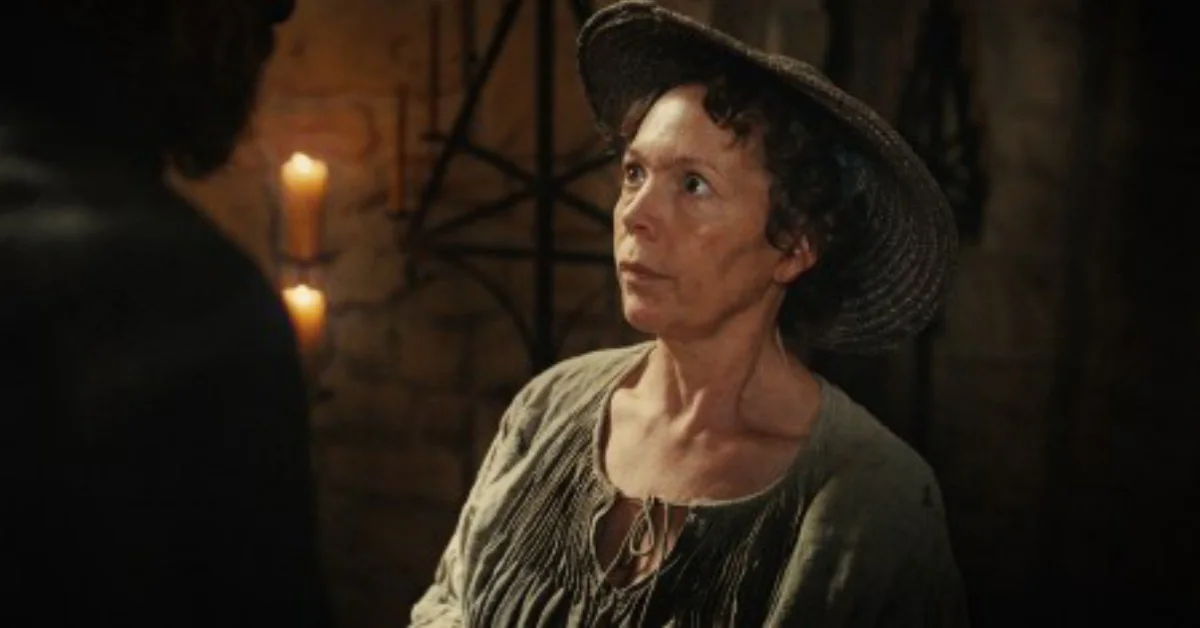
Colman plays a fisherwoman living in a muddy, isolated village that feels loosely set in 1600s England, though the filmmakers are careful not to tie it to a specific place or time. This is a world with its own strange rules. People are known only by their jobs. Brides wear metal collars. Magic is treated with a shrug. And women, especially unmarried ones, are expected to keep their heads down and their desires quiet.
That last rule is the one Colman’s character breaks.
Lonely, judged, and tired of being treated as lesser-than, Fisherwoman visits the local Basket Weaver (played with gruff mystery by Peter Dinklage) and asks him to make her a husband — out of wicker. It’s a choice that feels desperate at first, almost sad. But when the finished product shows up, the tone quickly shifts.
The wicker husband is played by Skarsgård, towering, handsome, and gently amused by the chaos he causes simply by existing. He is kind. He listens. He works hard. He satisfies his wife emotionally and physically. In short, he’s everything the other husbands in town are not — and the village can’t handle it.
What makes Wicker feel fresh isn’t just the joke of a literal “perfect man.” It’s the way the film watches the ripple effects of that perfection. The men bristle with insecurity. The women feel a mix of envy, hope, and unease. Elizabeth Debicki, as the icy and status-obsessed Tailor’s Wife, becomes the story’s sharpest observer and quiet antagonist, threatened by a shift in power she can’t control.
From this angle, Wicker isn’t really a romance. It’s a social experiment.
Wilson and Fischer, whose previous film Save Yourselves! blended comedy and discomfort, are clearly interested in systems — who benefits from them, who gets crushed, and what happens when one person refuses to play along. The wicker husband upends a patriarchal order that depends on women accepting disappointment as fate. His presence exposes just how low the bar has been set.
Still, the movie isn’t blind to the uneasy parts of its own premise. A man built to serve raises obvious questions. Is love still love when it’s ordered? Can devotion be real if it’s designed? The filmmakers don’t dodge these issues. Instead, they let them sit in the story, adding tension beneath the whimsy.
Colman is key to making that tension work. She plays Fisherwoman not as a wide-eyed dreamer, but as someone deeply aware of risk. Her performance is funny, raw, and quietly brave. When her character begins to soften — allowing herself to hope, to rely on someone else — it feels earned. You sense how dangerous vulnerability has been for her in the past.
Skarsgård, meanwhile, leans into understatement. His wicker husband isn’t a loud fantasy. He’s gentle, curious, and observant, often reacting to human cruelty with calm confusion. That choice makes him less of a joke and more of a mirror. Through him, the film reflects the absurdity of customs people accept simply because “that’s how it’s always been.”
Much of the film’s pleasure comes from watching the town react. Small moments — a shared glance, a cutting remark, a failed attempt at control — build a larger picture of a community under stress. Some characters grow. Others double down. And a few meet darker ends, reminding viewers that change is rarely painless.
Visually, Wicker is a treat. Cinematographer Lol Crawley fills the screen with rich, earthy colors that make the village feel both grimy and magical. Renátó Cseh’s production design adds texture to every frame, from crooked homes to ritual objects that hint at long-held beliefs. The world feels lived-in, not decorative, which grounds the film even as it drifts into fable.
The dialogue, too, deserves credit. It’s stylized without being stiff, playful without losing bite. Wilson and Fischer clearly enjoy language, letting words curl and clash in ways that feel theatrical but human. The humor can be bawdy, even shocking at times, but it’s never empty. Sex in Wicker isn’t there to titillate — it’s there to expose imbalance.
If the film stumbles, it’s near the end. Like many fables, Wicker insists on spelling out its lesson. The final stretch lingers a bit too long on consequences and conclusions, softening the impact of what had been a brisk, confident ride. Still, the message lands: partnerships work best when both people are seen, heard, and valued.
What’s striking is how timely the film feels. In an era where conversations about emotional labor, equality, and outdated traditions are louder than ever, Wicker uses the past to talk about the present. It suggests that resistance to change isn’t new — and neither is the cost of refusing to evolve.
There’s also something refreshing about a movie that trusts humor to carry heavy ideas. Wicker doesn’t lecture. It laughs, nudges, and occasionally stings. It knows that satire can slip past defenses faster than sermons ever could.
By the time the credits roll, Wicker has done more than entertain. It’s started a conversation — about marriage, about expectations, about what we owe each other when we choose to share a life. And it does so with warmth, mischief, and a slightly wicked smile.
For Colman, the film is another reminder of why she’s one of the most compelling actors working today. She makes Fisherwoman specific and universal all at once. For Skarsgård, it’s a clever subversion of his leading-man image. And for Wilson and Fischer, it’s proof that strange stories can still feel deeply human.
In the end, Wicker isn’t about finding the perfect partner. It’s about realizing you deserve better than disappointment — and daring to imagine something else. Whether your town is made of mud or modern glass, that idea feels pretty timeless.
PHOTO CREDIT: Lol Crawley/Courtesy of Sundance
