
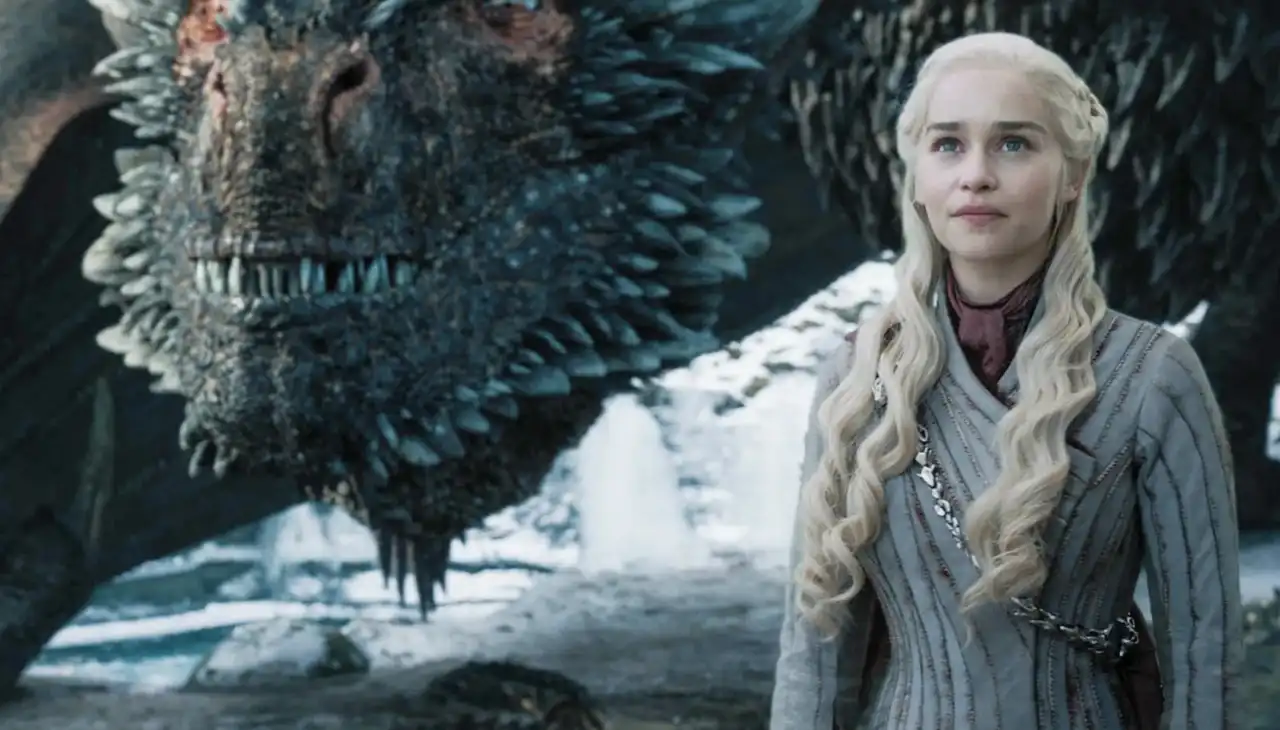
The actress opens up about her most terrifying medical battles — and the charity she built from the wreckage
Emilia Clarke, the actress who became a global household name playing Daenerys Targaryen on HBO’s Game of Thrones (2011–2019), is speaking out about one of Hollywood’s best-kept secrets — two life-threatening brain hemorrhages she suffered while filming the blockbuster series.
In a raw and deeply personal appearance on the How To Fail with Elizabeth Day podcast, the 39-year-old star admitted that after her second hemorrhage, she was fully convinced her death was inevitable.
“I was just convinced that I had cheated death and I was meant to die,” Clarke said. “Every single day, that’s all I could think about.”
Clarke’s first brain hemorrhage struck without warning at a London gym, shortly after she wrapped filming on Season 1 of Game of Thrones. She was in the middle of a plank exercise when a blinding, unbearable headache stopped her cold.
“Imagine an elastic band snapping around your brain,” she said. “That insane pressure.”
READ MORE: ‘Game of Thrones’ Film Gets Official Title, Will Focus on Aegon Targaryen’s Story
Doctors diagnosed her with a Subarachnoid Hemorrhage (SAH) — a severe and life-threatening type of stroke caused when an aneurysm, a balloon-like bulge in an artery, ruptures and bleeds into the space surrounding the brain. SAH accounts for roughly 5 percent of all strokes but carries the highest fatality rate of any stroke type. Approximately 10 percent of patients don’t even make it to the hospital alive.
Clarke underwent a three-hour emergency procedure in which a catheter was guided from her groin all the way up to her brain, where tiny platinum coils were used to seal off the ruptured aneurysm and stop the bleeding.
The medical crisis didn’t end there. After the surgery, Clarke developed aphasia — a communication disorder triggered by brain trauma — that temporarily robbed her of the ability to speak clearly or memorize lines. For an actress, it was a terrifying setback.
Behind the scenes, Clarke and her agent worked urgently to keep HBO in the dark — at least until it was clear she was going to survive. She informed showrunners David Benioff and D.B. Weiss but kept the rest of the world completely in the dark.
“I was so ashamed,” she said. “I didn’t want the people who hired me to think I could be broken.”
Clarke returned to the Game of Thrones set and continued filming as if nothing had happened. But the fight was far from over.
In 2013, after wrapping Season 3, a routine brain scan revealed that a second aneurysm — which doctors had been monitoring since the first hemorrhage — had doubled in size and required immediate surgery. During the procedure, the surgery went wrong. The coiling failed, triggering a massive bleed that forced doctors to perform emergency open brain surgery on the spot.
“My parents were sitting outside,” Clarke recalled. “And the doctors kept coming out every half hour saying, ‘We think she’s going to die.'”
Survival, she said, brought no relief. “It wasn’t ‘I survived, I feel great,'” Clarke explained. “It was the complete opposite — ‘I’m not supposed to be here. This is going to come back and get me.'”
Every headache that followed carried a shadow of dread. Yet even while promoting Game of Thrones at San Diego Comic-Con shortly after surgery, Clarke pushed through — telling herself, “If I’m going to die, I’ll do it on live TV.”
In March 2019, Clarke and her mother Jenny co-founded SameYou, a brain injury recovery charity launched with guidance from the United Kingdom’s Stroke Association. The name itself carries a powerful message.
The idea was born in a hospital corridor, where Clarke’s family took turns sitting on an old, broken chair during her recovery. They made a quiet promise: once Emilia got better, they would buy the hospital a new sofa — for every other family facing their darkest hour in that same hallway.
“Regardless of what you’re left with after a brain injury, you just want to be treated as though you were the same as before,” Clarke said. “The same value. The same person.”
Today, SameYou operates as a digital charity partnering with world-class institutions including Harvard Medical School’s Spaulding Rehabilitation Network, University College London, and the London School of Economics — conducting groundbreaking research and developing new therapies for brain injury survivors.
In recognition of their work, both Emilia and her mother Jenny were awarded MBEs — Member of the British Empire honors — by the UK government.
Clarke often uses her platform to highlight just how widespread brain injury really is. “One in three people will suffer a brain injury in their lifetime,” she has said. “That’s nearly double the number of people who will develop dementia — and yet almost no one talks about it.”
Looking back, Clarke describes Game of Thrones as the most complicated and precious chapter of her life — one she couldn’t have survived without her work keeping her grounded.
“Without my work, I don’t know what I would have done,” she said.
As for the show that made her famous? “It was lightning in a bottle,” Clarke said simply. “That was my youth.”
